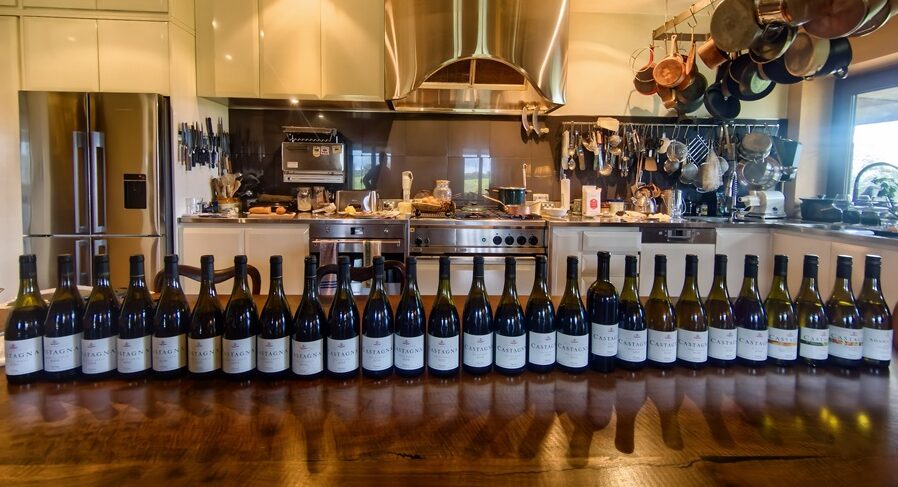
There is a particular pleasure in tasting a wine across decades. Beyond the individual vintages, a vertical tasting reveals something more enduring: the character of a place, the philosophy of a winemaker and the qualities that remain constant as the years pass.
For us, that consistency is found in finesse.
A recent double vertical tasting of Genesis Syrah and Un Segreto, conducted at the winery with Chinese wine writer, and critic Hao Shen, offered a remarkable opportunity to explore that idea. Tasting wines from 2002 through to 2021, Shen observed that Julian has “consistently made refined and balanced wines for decades” — a quality that becomes increasingly apparent with bottle age.
“Differ from Giaconda that has more focus on power, the theme of Castagna is invariably the fineness.”
It is a distinction that speaks to the heart of Castagna. These are not wines built around sheer weight or immediate impact. They are wines of detail, tension and texture, where perfume, savoury complexity, acidity and fine tannin come together to create something that continues to evolve in the glass — and in the cellar.
Castagna’s wines begin in a certified biodynamic vineyard, where low-yielding, 30-year-old vines grow in granitic loams over clay soils. The grapes are hand-picked and fermented with indigenous yeast in open wooden vats and stainless-steel tanks, before being aged for less than two years in French barriques, around 30% of which are new. The approach is considered and restrained. It allows the vineyard, the season and the fruit to remain central, while giving the wines the structure and composure required for long-term ageing.
With approximately 2,000 cases produced across the estate, Castagna’s wines are rare by nature. But rarity is only part of their appeal. Their real distinction lies in their ability to develop without losing their identity. The Genesis Syrah vertical demonstrated that quality of ageing with particular clarity. The 2002, at 24 years of age, was still remarkably fresh and youthful. Shen described a complex bouquet of nectar, sweet spices, red liquorice, pomelo peel, raspberry, black tea, cedar and cookie, with tertiary aromas beginning to emerge after aeration. On the palate, it was “chocolaty yet acidic”, textured and firm, underpinned by powdery tannin.
It was a compelling reminder that maturity does not necessarily mean softness or decline. In a wine with the right balance, age can bring greater detail while preserving energy. The 2013 showed “stunning precision”, with dried flower, blackberry, hawthorn, underbrush and spicy-mineral notes. The 2014 was described as “detailed and noble”, with an airy, perfumed and limpid character, while the 2015 offered juicy black cherry, savoury mineral notes, dark plum, cocoa and dried violet.
The 2019, still youthful, was perhaps the clearest expression of Genesis Syrah’s potential. Following a brief period of aeration, the wine revealed an alluring, classy nose, leading to “striking tension and compactness”. Shen considered it still too young to drink now, comparing its style to a Bourgogne-like Syrah and suggesting that its nose might eventually evoke a first-rate Clos de la Roche. It is a striking observation, but one that captures the ambition of Genesis Syrah: not to imitate another region, but to demonstrate how much nuance, perfume and longevity can be found in a cool-climate Australian Syrah. The 2021, too, showed promise — delightful on the nose, more austere on the palate, and built for further time in bottle.
The Un Segreto vertical revealed a similarly consistent philosophy, expressed through a different wine. Across the vintages, Shen noted a recurring combination of freshness, mineral character, florality and finely judged structure. The 2013 was polished, tense and compact, with undergrowth, dried flower, stone, spices and black plum. Despite being made in a difficult vintage, it showed “incredible longevity”. The 2014 was more feminine in style, with ginger, raspberry, dried flower and spice, while the 2015 brought fleshy fruit, leather, chocolate and spice, alongside a distinctly salty palate.
The 2016 was shy at first, but revealed sharp, explosive acidity and subtle salinity. The 2017 displayed an austere, fresh nose of jasmine tea, raspberry, crushed stone, herb and cinnamon, with “stunning acid” filling the mineral-driven palate. The 2018 was more generous, offering ripe fruit and nectar-like florality, while the 2019 showed depth beneath its freshness, with scrub, spice, minerality, fruit and florality in balance. The 2021 was fresh and precise, with dried cherry, tomato, earth, spice, stone and dried flower. Like the Genesis Syrah of the same vintage, it showed the structure and restraint to develop beautifully over time.
A vertical tasting is ultimately about more than how individual bottles perform. It is an opportunity to ask what remains constant — and what that consistency tells us about the person making the wine. For Castagna, the answer is clear. Across two decades of Genesis Syrah and Un Segreto, the wines retain a recognisable sense of balance, freshness and refinement. They evolve, but they do not lose their identity.
As Shen reflected:
“The greatest wines must be those can genuinely express the winemakers themselves, and must be those able to reveal decennary stability.”
That is perhaps the most meaningful measure of longevity. Not simply whether a wine can survive in bottle, but whether it can continue to express its origin, its maker and its character as it changes.
At Castagna, that expression is one of finesse, and it is a quality that time only makes more apparent.
Read the full write up from Shen, and his reviews of the wines here.